
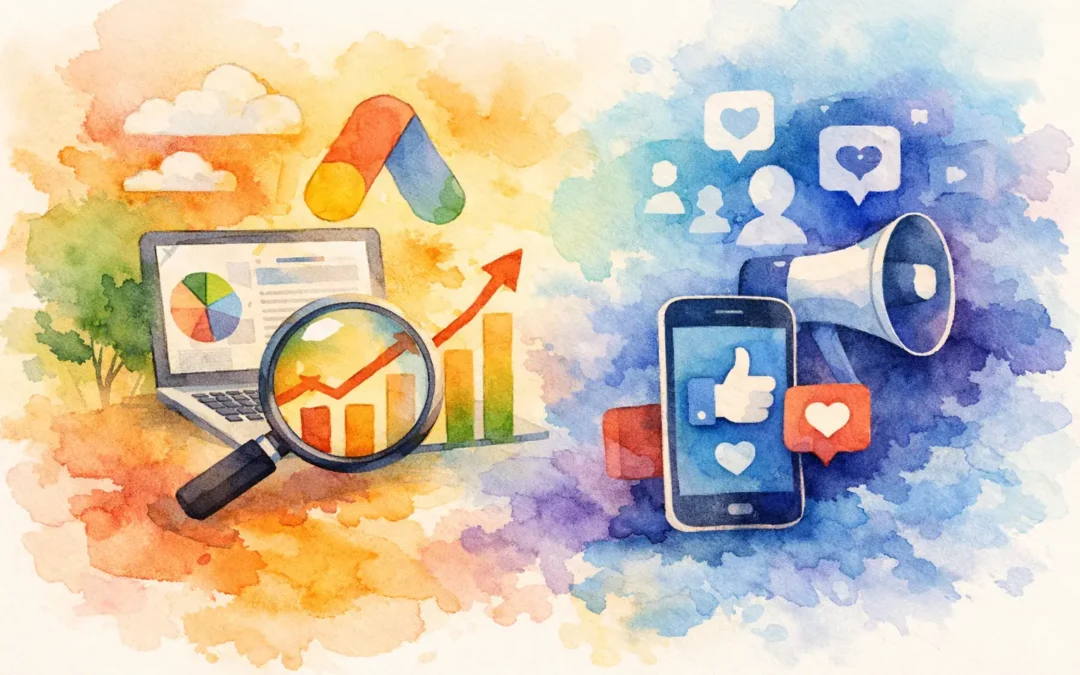
A prospect searching “emergency dentist near me,” “used Ford F-150 for sale,” or “custom kitchen cabinets” is already close to making a decision. That is the central difference in Google Ads vs Facebook Ads: Google captures existing demand, while Facebook creates and develops demand before a customer starts searching. Both can produce real growth, but they should not be judged by the same standard.
For business owners, the wrong choice is rarely a bad platform. It is putting budget into a campaign that does not match how customers buy, then calling paid advertising ineffective. The right channel depends on your offer, sales cycle, local competition, creative assets, and how quickly you need qualified leads.
Google Ads vs Facebook Ads: The Core Difference
Google Ads is intent-based advertising. Your business appears when someone searches for a product, service, brand, or solution. If a homeowner types “roof repair company near me,” the search itself signals a problem and a willingness to evaluate providers. A well-built campaign can place your offer in front of that prospect at the moment action is most likely.
Facebook Ads, which run through Meta’s advertising platform, are interruption-based. People are not typically scrolling Facebook or Instagram looking to schedule a dental implant consultation or purchase a new sectional. They are catching up with friends, watching videos, or browsing content. Your ad needs to earn attention first, explain the value quickly, and give the viewer a reason to respond.
That distinction affects everything: ad copy, landing pages, targeting, budget expectations, and how you measure success. Google usually delivers fewer surprises in buyer intent. Facebook often gives you more control over who sees the message and more room to build awareness at scale.
When Google Ads Is the Better Lead Generation Channel
Google Ads is usually the first paid channel to test when your business sells something people actively search for. Local service companies, dental practices, auto dealers, manufacturers, repair providers, legal firms, and B2B businesses can often benefit because their prospects use search engines to compare options.
The strongest Google Ads campaigns focus on commercially valuable searches, not traffic for traffic’s sake. A dental clinic may prioritize “dental implants financing” over broad informational searches about tooth pain. A used car dealer may build campaigns around specific makes, models, and local inventory terms. A furniture retailer may target searches for product categories with healthy margins and clear buying intent.
Google also works well when speed matters. If your website is conversion-ready and your offer is competitive, a search campaign can begin generating calls and form submissions soon after launch. That does not mean the work ends there. Account structure, negative keywords, location settings, ad assets, conversion tracking, and landing page quality all determine whether clicks turn into profitable inquiries.
The trade-off is cost and competition. High-intent keywords can be expensive, especially in competitive metro areas and industries such as legal, automotive, home services, and healthcare. A high cost per click is not automatically a problem. Paying $20 for a click can make sense if it produces a $2,000 job. Paying $2 for a click is a problem if those visitors never become customers.
When Facebook Ads Has the Advantage
Facebook Ads is a powerful choice when people need to see, understand, or want your product before they search for it. This is particularly true for visually driven offers, new brands, promotional campaigns, lifestyle products, events, and businesses with a longer consideration cycle.
A furniture business can use strong video and lifestyle imagery to show how a collection looks in a real home. A dealership can promote trade-in offers, financing programs, or new arrivals to local audiences. A clinic can build awareness around cosmetic services, then follow up with people who watched its videos or visited its website. The platform gives advertisers opportunities to tell a story that a short search ad cannot carry.
Facebook’s targeting strengths are valuable, but they are often misunderstood. You can define audiences by geography, broad interests, engagement behavior, and first-party data such as customer lists and website visitors. Still, targeting alone will not rescue weak creative or an unclear offer. The ad must stop the scroll, establish credibility, and make the next step feel worthwhile.
Lead costs on Facebook can look attractive compared with Google, especially when using native lead forms. But lower cost per lead does not always mean better economics. Some people submit forms quickly because the process is easy, then do not answer their phone or have little urgency. Businesses need fast follow-up, qualification questions, and CRM tracking to determine which leads actually turn into appointments, quotes, and sales.
Compare Lead Quality, Not Just Cost Per Lead
The most expensive mistake in paid media is optimizing for a number that looks good in a monthly report but does not increase revenue. Cost per lead matters, yet it is only one part of the picture. A campaign should be evaluated from click to closed deal.
Google Ads often produces stronger immediate intent because the customer initiated the search. Facebook Ads can create a larger pipeline at a lower front-end cost, but the leads may require more nurturing. For a high-ticket manufacturer or custom furniture company, that can be perfectly acceptable if sales follow-up is organized and patient. For an emergency repair business, search intent is usually more valuable because the buyer needs help now.
Track phone calls, qualified forms, booked appointments, showroom visits, quote requests, and closed revenue whenever possible. If your sales team can identify which leads became customers, advertising decisions become far more confident. You can shift budget toward the campaigns, audiences, and keywords that produce profitable outcomes rather than chasing vanity metrics.
Your Website Determines Whether Either Platform Performs
Ads bring opportunities to your website or lead form. They do not fix an outdated site, slow mobile experience, unclear service pages, or a contact process that makes prospects work too hard. A strong campaign can expose weak conversion paths faster, but it cannot overcome them indefinitely.
Google Ads usually needs tightly matched landing pages. Someone searching for commercial HVAC service should land on a page about commercial HVAC service, not a generic home page with ten unrelated offerings. Facebook traffic often needs more context, especially when the audience is seeing your brand for the first time. Use clear visuals, proof, key benefits, and a direct call to action.
Trust signals matter on both channels. Reviews, recognizable credentials, financing information where applicable, project photos, inventory details, before-and-after examples, and fast response times can move a prospect from interest to action. The goal is not simply to generate more leads. It is to give qualified prospects enough confidence to choose you.
A Practical Budget Decision for Growing Businesses
If you have limited budget and a service people actively search for, start with Google Ads. Focus on a defined service area, your highest-value offers, and a landing page built to convert. This approach is especially effective for local businesses that need calls and quote requests now.
If you sell visually appealing products, are introducing a new offer, or need to expand demand beyond search volume, add Facebook Ads. Use it to build recognition, promote compelling offers, and re-engage people who already visited your site. Do not expect cold social traffic to behave exactly like search traffic. Give it an appropriate message and a realistic conversion path.
For many established businesses, the best answer is not Google or Facebook. It is a connected system. Google captures people ready to buy. Facebook keeps your brand visible, introduces your offer to new audiences, and brings previous visitors back into the conversation. Retargeting can make that connection even stronger, provided your tracking and creative are handled properly.
Build the Channel Mix Around Your Sales Process
There is no universal winner between Google Ads and Facebook Ads. A dental office seeking appointment calls may lean heavily into paid search. A furniture retailer with exceptional product photography may see major value from Facebook and Instagram campaigns. A used car dealer may need both: search campaigns for shoppers comparing vehicles today and social campaigns that promote inventory, financing, and trade-in opportunities.
The winning strategy starts with business goals, not platform preference. Set up accurate tracking, build pages that earn inquiries, respond to leads quickly, and review results against revenue. At Digital Marketing 401, that is how we approach paid media: as a measurable growth channel connected to creative, websites, and sales outcomes.
Choose the platform that matches where your customer is in the buying journey, then give that platform the strategy and follow-up it deserves. That is how ad spend becomes a reliable source of growth instead of another monthly expense.