
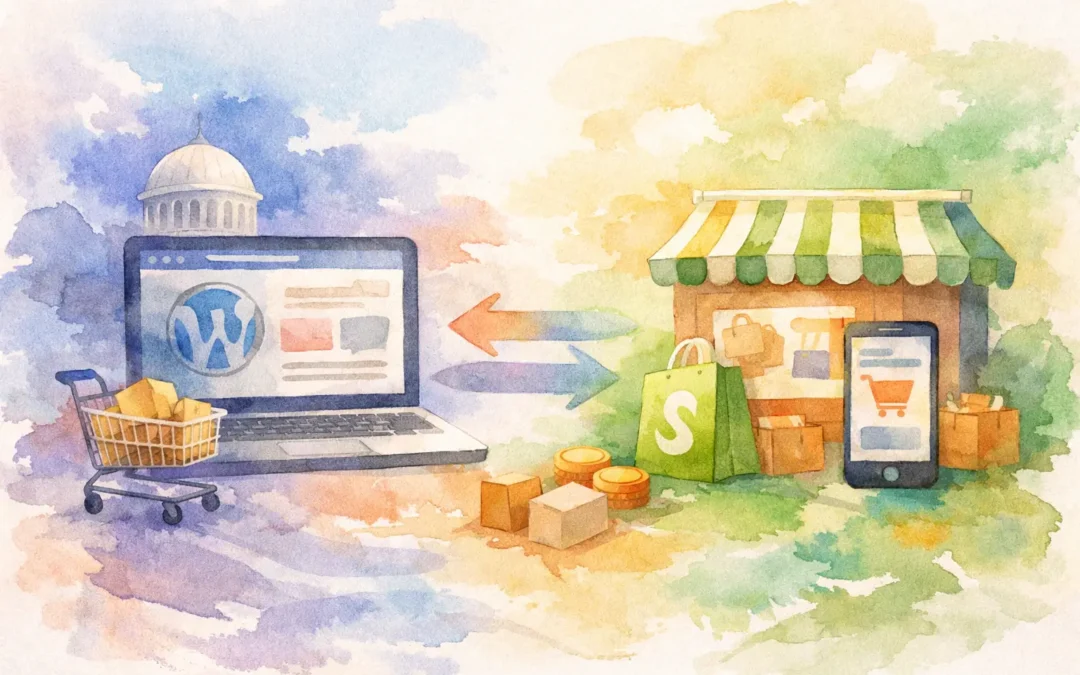
A store can look polished and still lose revenue when the platform underneath it cannot support how customers search, browse, and buy. The WordPress Shopify decision is not about choosing the most popular name. It is about choosing the system that gives your business the strongest path to traffic, conversions, and operational control.
For a local retailer, manufacturer, furniture business, or growing product brand, the wrong choice creates expensive friction. Marketing campaigns become harder to track, product updates take too long, SEO pages are limited, or checkout issues cost sales. The right platform gives your team a foundation that supports growth instead of forcing workarounds every quarter.
WordPress Shopify: The Core Difference
Shopify is an eCommerce-first platform. It is built to help businesses launch and manage online stores with product catalogs, payments, inventory tools, shipping settings, and checkout functionality ready to configure. Its biggest advantage is speed to market. A business can get a professional store online quickly without managing hosting, security patches, or major platform updates on its own.
WordPress is a content management system that becomes an online store through WooCommerce. It offers much more flexibility over design, content, SEO structure, functionality, and integrations. That freedom is valuable, but it also means the quality of the build matters. A poorly configured WordPress store can become slow, difficult to maintain, and vulnerable to plugin conflicts.
Neither platform automatically generates leads or sales. Strong results come from the full system around the website: conversion-focused design, technical SEO, product photography, paid advertising, content, reputation management, and clear reporting. Your platform needs to support that system.
Choose Shopify When Selling Is the Immediate Priority
Shopify is often the practical choice for businesses that need to sell products online without a long development timeline. It is particularly effective for retailers with straightforward product catalogs, businesses moving from in-store sales to eCommerce, and brands that want internal staff to manage orders and inventory with minimal technical training.
The checkout experience is one of Shopify’s strongest selling points. It is designed around eCommerce conversion and maintained by Shopify, reducing the risk that a software update or custom checkout change disrupts payment processing. For a business investing in Google Ads, social campaigns, or email promotions, checkout reliability matters. You do not want to pay for traffic only to lose customers at the final step.
Shopify also works well for businesses with a clear, repeatable sales model. If you sell apparel, accessories, beauty products, packaged goods, or a focused line of retail items, its built-in systems can cover much of what you need.
The trade-off is control. Shopify gives you structure because it is a managed platform, but that structure can become limiting when your business has complex product logic, specialized quoting, advanced account permissions, custom wholesale requirements, or unique content needs. App subscriptions can also add up over time. A low monthly platform fee can turn into a significant ongoing software cost when every business requirement requires another app.
Choose WordPress When Content and Flexibility Drive Growth
WordPress is often the stronger option when your website needs to do more than process transactions. Manufacturers, dental groups selling products or membership packages, used car dealers, furniture stores, and service businesses with complex lead-generation needs often benefit from WordPress because content and customization are central to their growth strategy.
A well-built WooCommerce website gives your team greater control over product pages, category structures, landing pages, blog content, local SEO pages, and conversion paths. That matters when organic search is a major source of qualified traffic. You can build detailed product guides, comparison pages, location pages, project galleries, FAQs, and resource content without forcing your marketing strategy into a rigid store template.
For example, a furniture company may need product filtering, room-based collections, financing information, delivery zones, style guides, custom order inquiries, and locally optimized showroom pages. Shopify can handle part of this, but WordPress can provide more flexibility when the buying journey includes research, consultation, and high-ticket decisions before checkout.
WordPress also gives businesses more ownership over their website environment. You choose the hosting, development approach, plugins, integrations, and data structure. That control is powerful when managed by an experienced team. It can become a liability when there is no technical oversight, no update process, or no accountability for site speed and security.
SEO: Where Most Platform Decisions Go Wrong
Many business owners ask which platform is better for SEO. The honest answer is that both can rank. Search engines do not reward Shopify or WordPress simply because of the platform name. They reward useful pages, strong site architecture, fast performance, relevant authority, and content that answers search intent better than competing pages.
WordPress generally gives an SEO team more control over technical details and content expansion. You can create highly tailored page templates, organize content around customer questions, and build an information-rich site that supports both commercial and local search terms. This makes it a strong choice for businesses pursuing competitive SEO campaigns.
Shopify can also perform well in search, especially for product-focused stores with clean collections, optimized product descriptions, consistent internal linking, and a smart content strategy. The limitation appears when you need uncommon URL structures, deeply customized content layouts, or technical solutions that are outside Shopify’s standard framework.
The bigger mistake is treating SEO as a plugin, an app, or a one-time setup. Your store needs ongoing work: keyword research, content improvements, product page optimization, technical cleanup, image optimization, structured data checks, and conversion analysis. A first-page ranking is valuable only when it brings the right customer and turns into revenue.
Consider a Hybrid Setup for Complex Businesses
For some brands, WordPress versus Shopify is the wrong question. A hybrid setup can be the best commercial decision.
In this model, WordPress manages the main website, SEO content, service pages, educational resources, and high-conversion landing pages. Shopify manages the storefront and checkout. This approach can work for a brand that relies on content marketing and organic visibility but wants Shopify’s simplified commerce operations.
A hybrid build requires careful planning. Navigation, design, analytics, customer tracking, and inventory workflows must feel connected. If the experience is disjointed, customers may feel as though they have been sent to a different company when they move from your website to your store. It also creates more technical moving parts, so it is not the right choice for every small business.
Still, when built properly, the model gives growth-stage companies a strong balance of search visibility, content control, and conversion-ready selling.
Evaluate the Platform Against Your Real Sales Process
Do not choose a platform because a competitor uses it or because a theme looks impressive in a demo. Start with how your customers actually buy.
If customers purchase quickly from a clear catalog and your priority is launching a reliable store fast, Shopify is usually the better fit. If customers need to compare options, request quotes, visit a location, read detailed information, or interact with a more complex website before purchasing, WordPress may give you a stronger foundation.
Your internal capacity matters as well. Shopify reduces maintenance demands. WordPress requires dependable hosting, updates, backups, security monitoring, and professional development support. That does not make WordPress a bad investment. It means the investment should include ongoing technical accountability, not just the initial website build.
Also consider your marketing plan for the next 12 to 24 months. Are you planning to rank for hundreds of product and service searches? Will you run paid campaigns to custom landing pages? Do you need dealer portals, wholesale pricing, appointment booking, custom forms, financing tools, or integration with existing business systems? Those answers should shape the decision before design begins.
Build for Revenue, Not Just Launch Day
A website platform should make it easier to acquire customers, measure performance, and improve conversion rates over time. That requires more than selecting WordPress or Shopify. It requires a strategy that connects the site to search campaigns, Google Ads, product content, CRM workflows, analytics, and the sales process your team follows every day.
Digital Marketing 401 helps businesses evaluate the commercial side of the decision before development starts. Our in-house team can build the website, create the content and visuals, support SEO and paid traffic, and focus every stage on the metrics that matter: qualified leads, orders, revenue, and growth.
Choose the platform that fits your business model today, but do not build only for today. The best WordPress Shopify decision is the one that gives your business room to compete harder, market smarter, and sell more as demand grows.